
How to Compare Yoga Teacher Training Schools in Rishikesh Beyond Price and Yoga Alliance Registration
Rishikesh has become one of the most sought-after destinations for aspiring yoga teachers from India and abroad. Known for its traditional yoga heritage, spiritual environment and established yoga schools, the city attracts students who want to develop a deeper understanding of yoga and gain the skills required to teach others. However, with so many institutions offering a 200 hour yoga teacher training in Rishikesh, choosing the right school can be challenging.
Most students begin their search by comparing course fees and checking whether a school is registered with Yoga Alliance. While both factors are important, they do not provide a complete picture of the education, practical experience and overall learning environment a school offers.
A lower course fee does not necessarily mean better value, just as Yoga Alliance registration alone does not guarantee excellent teaching. A meaningful yoga teacher training experience depends on several other factors, including the curriculum, teachers’ qualifications, practical teaching opportunities, accommodation, class size, learning environment and the school’s approach to traditional yoga.
If you are considering yoga teacher training in Rishikesh, here are the important factors you should evaluate before selecting a school.
Examine the Curriculum Beyond the Number of Training Hours
The first thing to examine is the actual curriculum. Most schools advertise a 200-hour programme, but the subjects covered and the depth of instruction can vary considerably.
A well-structured 200-hour yoga teacher training should provide a balanced combination of practical yoga sessions, theoretical education and teaching methodology.
Before enrolling, check whether the curriculum includes:
- Hatha Yoga and Ashtanga Vinyasa Yoga
- Yoga anatomy and physiology
- Yoga philosophy and history
- Pranayama and breathing techniques
- Meditation practices
- Teaching methodology
- Alignment and adjustment techniques
- Mantra chanting
- Yoga ethics and lifestyle
- Practical teaching sessions
Do not simply count the number of subjects mentioned on a school’s website. Find out how much time is allocated to each subject and whether students receive sufficient practical instruction.
For instance, a programme may include several yoga styles but offer only limited exposure to some of them. Another school may concentrate on fewer styles while providing more detailed training in each.
Neither approach is automatically better. Your choice should depend on the kind of yoga teacher you want to become.
Understand the Teaching Experience and Qualifications of the Faculty
The quality of a yoga teacher training programme depends heavily on the people delivering it. Experienced teachers can help students understand the purpose behind different practices, correct alignment mistakes and develop a more thoughtful approach to teaching.
However, do not evaluate faculty members only by their certifications or years of experience.
Look into their actual teaching backgrounds and areas of specialisation.
Some useful questions include:
- How many years have the teachers been practising yoga?
- How many years of teaching experience do they have?
- Do different teachers handle specialised subjects?
- Does the school have qualified instructors for anatomy, philosophy and Ayurveda?
- Are students given opportunities to interact with teachers outside regular classes?
- Do instructors provide individual feedback during practical sessions?
A school with multiple specialist teachers may offer a more balanced learning experience than one where a single instructor handles every subject.
Also, consider whether teachers can explain complex concepts in a clear and practical manner. Understanding a yoga posture is one thing, but learning how to explain it, demonstrate it and guide different students safely requires additional teaching skills.
Evaluate Practical Teaching Opportunities
One of the most important aspects of a 200-hour yoga teacher training in India is the opportunity to practise teaching.
Knowing how to perform yoga postures does not automatically make someone a competent yoga instructor. Teaching requires the ability to communicate instructions, observe students, understand physical limitations and offer appropriate modifications.
A good programme should gradually introduce students to teaching through structured practice.
Find out whether the school includes:
- Individual teaching assignments.
- Practice sessions with fellow students.
- Opportunities to lead complete yoga classes.
- Training in verbal instructions and demonstrations.
- Alignment and adjustment practice.
- Feedback from experienced instructors.
- Assessment of practical teaching skills.
Ask how frequently students get to teach during the course. Some schools mention teaching methodology in their curriculum but do not provide enough time for students to practise independently.
The purpose of practical teaching is to help students become comfortable leading a class, managing different abilities and responding to common challenges.
Before booking, make sure the programme offers more than demonstrations and observation.
Compare the Depth of Yoga Styles Being Taught
Different yoga schools follow different teaching traditions and offer different combinations of yoga styles.
Some programmes focus mainly on Hatha Yoga, while others combine Hatha and Ashtanga Vinyasa. Multi-style programmes may also introduce Yin Yoga, Iyengar-inspired alignment practices, Restorative Yoga or Aerial Yoga.
When comparing schools, understand the difference between learning several styles and developing sufficient knowledge to teach them.
For example, Hatha Yoga and Ashtanga Vinyasa offer different approaches to physical practice. Hatha generally provides time to explore postures, alignment and breath coordination, whereas Ashtanga Vinyasa follows a structured sequence connected through movement and breath.
Yin Yoga introduces longer-held postures and a different approach to working with the body. Aerial Yoga uses a suspended fabric hammock to support selected postures and movements.
If you are considering a multi-style programme, ask:
- Which styles are taught as major subjects?
- How frequently are classes conducted?
- How many hours are dedicated to each style?
- Are additional styles taught throughout the course or only during selected days?
- Does the programme include separate teaching practice for these styles?
- Are additional certificates provided, and what do they cover?
These questions will help you understand whether a multi-style programme offers meaningful exposure or simply includes additional subjects in its course description.
Understand What Yoga Alliance Registration Actually Means
Yoga Alliance registration is an important consideration when choosing a best online yoga teacher training school, particularly if you intend to register as a Registered Yoga Teacher after completing your course.
However, students should understand the difference between a school’s registration and an individual’s teacher registration.
A Registered Yoga School (RYS) is a school registered with Yoga Alliance. A student who completes an eligible training programme at an appropriately registered school may apply for the corresponding Registered Yoga Teacher (RYT) credential, subject to Yoga Alliance’s requirements.
Before enrolling, verify the school’s registration directly through the official Yoga Alliance website.
Check the following:
- Is the school currently listed as a Registered Yoga School?
- Does its registration cover the course you intend to join?
- Is the school advertising the correct training category?
- What documentation will you receive after completing the programme?
- Are there any additional requirements for individual teacher registration?
Also, understand what additional certificates mean.
For example, some schools offer a 200-hour foundational teacher training along with additional 50-hour specialist training. These additional hours should not automatically be treated as an extension of the RYT 200 credential. Check whether they are offered as separate continuing education programmes and whether they meet the relevant YACEP requirements.
A school should explain its certification structure clearly rather than relying on impressive-looking course titles.
Look at Accommodation and the Residential Environment
A residential yoga teacher training programme involves spending several weeks at the school. Therefore, accommodation is not a minor consideration.
The quality of your living environment can influence your comfort, sleep, concentration and ability to follow an intensive daily schedule.
Before booking, examine the available accommodation options.
Important factors include:
- Room sharing arrangements.
- Attached bathrooms and hot water.
- Mattress quality and bedding.
- Ventilation and natural light.
- Storage facilities.
- Wi-Fi availability.
- Cleanliness and maintenance.
- Access to laundry facilities.
- Availability of private rooms.
If possible, request recent photographs or videos of the actual rooms rather than relying entirely on promotional images.
You should also understand the surroundings. Some students prefer staying close to the busy areas of Rishikesh, while others prefer a quieter environment away from tourist activity.
A school situated near the Ganges, surrounded by greenery and away from crowded commercial areas, may offer a more peaceful setting for daily practice and study.
However, check the distance from essential shops, medical facilities and transport services before making a decision.
Examine the Food Quality and Daily Meal Arrangements
Food is another important factor during an intensive residential course.
Most traditional yoga schools in Rishikesh follow a vegetarian or sattvic meal plan. However, the quality, variety and timing of meals can differ between institutions.
Ask the school about its daily meal arrangements.
For example:
- How many meals are included?
- Are breakfast, lunch and dinner provided?
- Are meals freshly prepared?
- Is drinking water filtered?
- Are fruits and seasonal vegetables included?
- Can the school accommodate specific dietary requirements?
- Are meals provided on weekly days off?
Also, understand the school’s dietary rules before booking. Some institutions do not permit meat, fish, eggs, alcohol or certain outside food during the programme.
A balanced meal plan can make a considerable difference when students are attending multiple yoga sessions and theory classes every day.
Do not assume that all-inclusive pricing means every meal and beverage is covered throughout the entire stay. Read the inclusions carefully.
Study the Daily Schedule and Overall Course Intensity
A 200-hour yoga teacher training is an intensive educational programme. Students usually attend several practical and theoretical sessions throughout the day.
Before selecting a school, examine its daily schedule rather than relying only on the total number of training hours.
A properly planned timetable should provide a reasonable balance between physical practice, theoretical learning, meals, rest and personal study.
Look for:
- Morning asana sessions.
- Pranayama and meditation.
- Anatomy and physiology classes.
- Yoga philosophy.
- Alignment and adjustment.
- Teaching methodology.
- Evening yoga sessions.
- Independent study and practice time.
Pay attention to the frequency of each subject. For example, if you are interested in Ashtanga Vinyasa, check whether it is taught regularly or only on selected days.
Also, understand the course duration. A programme completed over 25 days will have a different daily intensity from one spread across a longer period.
Ask whether Sundays are reserved for rest, self-practice or independent study. Clarify whether the advertised duration includes arrival and departure days.
This will help you assess whether the programme matches your physical capacity and learning expectations.
Compare the Complete Course Fee, Not Just the Advertised Price
Course fees are often one of the first things students compare. However, comparing only the starting price can lead to an inaccurate understanding of the actual value.
A school advertising a lower price may charge separately for accommodation, meals, airport transfers, study materials or other facilities.
Another institution may offer a higher initial fee but include most of these services in one package.
When comparing prices, prepare a list of everything included.
| Expense | What to verify |
| Tuition | Does it cover all scheduled subjects? |
| Accommodation | Is the room private or shared? |
| Meals | How many daily meals are included? |
| Study material | Are books and course notes provided? |
| Airport transfer | Is pickup and drop included? |
| Laundry | Is laundry available, and what are the limits? |
| Certification | Are examination and certificate charges included? |
| Additional activities | Are excursions or wellness treatments included? |
You should also check the deposit amount, payment deadline, cancellation policy and refund conditions.
A transparent fee structure makes it easier to plan your expenses and avoid unexpected costs during your stay.
The objective should be to find a programme that offers good educational value, comfortable living arrangements and reliable support, rather than simply selecting the cheapest option.
Read Reviews Carefully and Look for Consistent Feedback
Reviews can help you understand what previous students experienced during their training. However, reading only the overall star rating is not enough.
Look for detailed feedback that discusses specific aspects of the programme.
Pay particular attention to comments about:
- Teaching quality and faculty involvement.
- Practical teaching opportunities.
- Accommodation cleanliness.
- Food quality and hygiene.
- Course organisation.
- Management responsiveness.
- Learning environment.
- Certification process.
Try to identify patterns across multiple reviews rather than relying on one exceptionally positive or negative experience.
Reviews on independent platforms, including Google and Yoga Alliance, can provide useful perspectives.
You can also ask the school whether it can connect you with former students who are willing to share their experiences.
Most importantly, compare what students describe with what the school advertises. Consistency between the promised programme and actual student experiences is a positive sign.
Understand the School’s Rules, Policies and Student Support
Yoga teacher training involves living and studying with people from different countries and backgrounds. A school’s policies help maintain an organised and respectful learning environment.
Before booking, request a copy of its terms and conditions.
Read the rules concerning:
- Attendance requirements.
- Examinations and certification.
- Medical conditions and physical limitations.
- Vegetarian food and dietary restrictions.
- Alcohol, smoking and prohibited substances.
- Weekend outings and entry timings.
- Accommodation maintenance.
- Personal belongings.
- Photography and video permissions.
- Cancellation and refund policies.
Also, check how the school handles student concerns.
Will management be available if you face difficulties with accommodation, classes or other arrangements? Is there a clear process for raising complaints?
A well-managed school should communicate its expectations before students arrive, not introduce important restrictions after enrolment.
Understanding these details in advance helps you decide whether the school’s environment and rules are suitable for you.
Check Whether the School’s Teaching Approach Matches Your Goals
Finally, consider what you want to achieve after completing your training.
Some students want to teach yoga professionally. Others want to deepen their personal practice, understand yoga philosophy or explore different approaches to physical and mental wellbeing.
Your objectives should influence your choice of school.
If you want to teach traditional yoga, look for a strong foundation in Hatha Yoga, philosophy, pranayama and meditation.
If you are interested in dynamic group classes, examine the depth of Ashtanga Vinyasa training and teaching methodology.
If you want to work with slower, more restorative practices, consider whether the school offers meaningful Yin Yoga or Restorative Yoga education.
Students interested in exploring different teaching approaches may find a multi-style programme more suitable.
Do not select a school simply because it offers the largest number of subjects. Choose one whose curriculum, teaching approach and practical training opportunities support your longer-term goals.
Why Choose Arohan Yoga School for Your 200-Hour Training in Rishikesh?
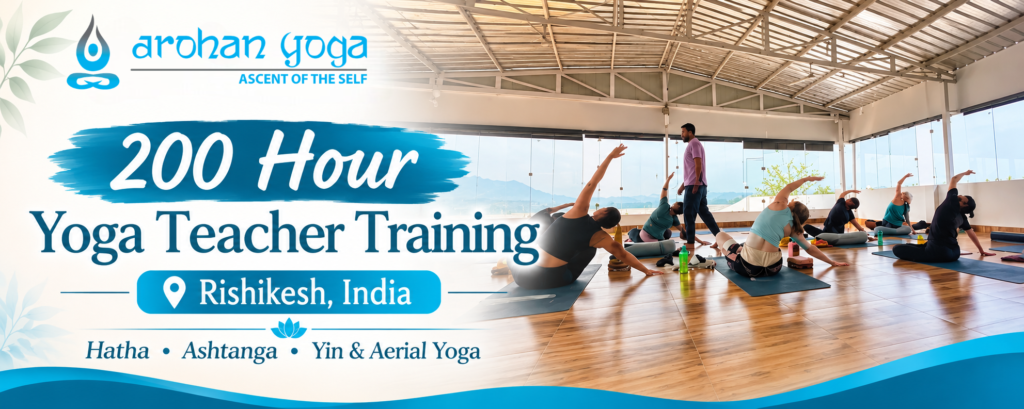
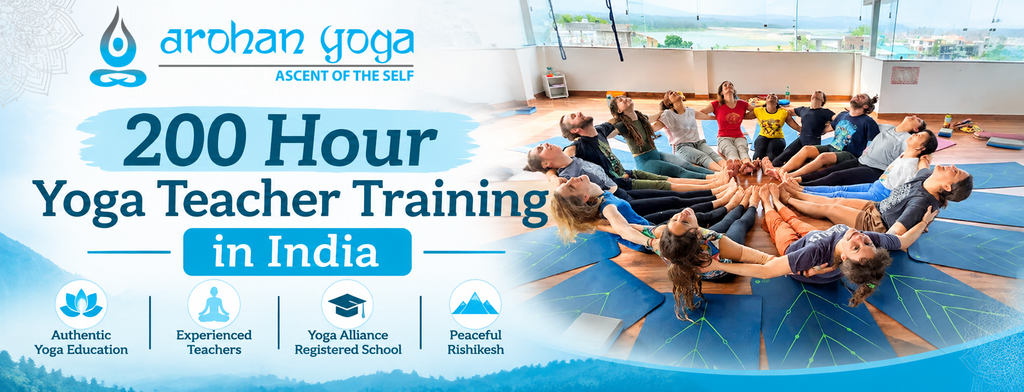
At Arohan Yoga School, we believe that quality yoga education should combine traditional knowledge, practical teaching experience and a comfortable residential environment. Our 200-hour Yoga Teacher Training Track 3 brings together Hatha Yoga and Ashtanga Vinyasa as major subjects, with Yin Yoga and Aerial Yoga as additional styles. Students receive 200 hours of foundational teacher training along with 50 additional hours of Yin and Aerial Yoga training, with a separate YACEP certification for the additional programme.
Our curriculum also covers yoga anatomy, philosophy, pranayama, meditation, teaching methodology, alignment, adjustment, detox techniques and Ayurveda basics. As a Yoga Alliance Registered Yoga School (RYS ID 231188), we provide structured training with multiple specialist teachers, practical teaching opportunities and regular assessments. Our riverside residential campus in Rishikesh offers comfortable accommodation options, daily vegetarian meals, spacious yoga halls, a large garden and views of the Ganges and surrounding mountains. We also include facilities such as airport transfers on designated arrival and departure days, laundry services, excursions and a complimentary Ayurvedic massage. We aim to provide a learning environment where students can develop their practice, understand the principles of yoga and gain the confidence to share their knowledge with others.
Conclusion
Choosing the right yoga teacher training school in Rishikesh requires more than comparing course fees and checking Yoga Alliance registration. The quality of the curriculum, teaching experience of the faculty, practical training opportunities, accommodation, food, daily schedule and student support all contribute to the overall learning experience.
Take time to examine these factors before making your decision. Ask detailed questions, verify important claims, read independent reviews and understand the school’s policies.
Whether you choose a traditional Hatha-focused programme or a multi-style course, make sure the training provides a strong foundation in both the practice and teaching of yoga.
A well-chosen 200-hour yoga teacher training in India can be an important step towards developing your knowledge, refining your personal practice and preparing for the responsibilities of teaching yoga.
Frequently Asked Questions
Look beyond course fees and Yoga Alliance registration. Evaluate the curriculum, teachers’ qualifications, practical teaching opportunities, class sizes, accommodation, food quality, daily schedule and student reviews. Also, check the school’s certification process, attendance requirements and refund policies before enrolling.
No. Yoga Alliance registration indicates that a school is registered under the organisation’s applicable standards, but it does not automatically guarantee teaching quality or student satisfaction. You should also examine faculty experience, curriculum structure, practical training and feedback from former students.
Practical teaching experience is essential because performing yoga postures and teaching them are different skills. Students should receive opportunities to lead classes, practise verbal instructions, understand alignment and adjustments, and receive feedback from experienced instructors.
A single-style programme focuses on developing a deeper understanding of a particular yoga tradition, while a multi-style programme introduces students to different approaches. For example, a multi-style course may combine Hatha, Ashtanga Vinyasa, Yin and Aerial Yoga, offering exposure to different teaching methods and practices.
Arohan Yoga School offers a multi-style Track 3 programme combining Hatha, Ashtanga Vinyasa, Yin and Aerial Yoga. The programme includes 200 hours of foundational training and an additional 50 hours of Yin and Aerial Yoga training with a separate YACEP certification. Students also receive practical teaching experience, specialist instruction, residential accommodation, vegetarian meals and access to a riverside campus near the Ganges.